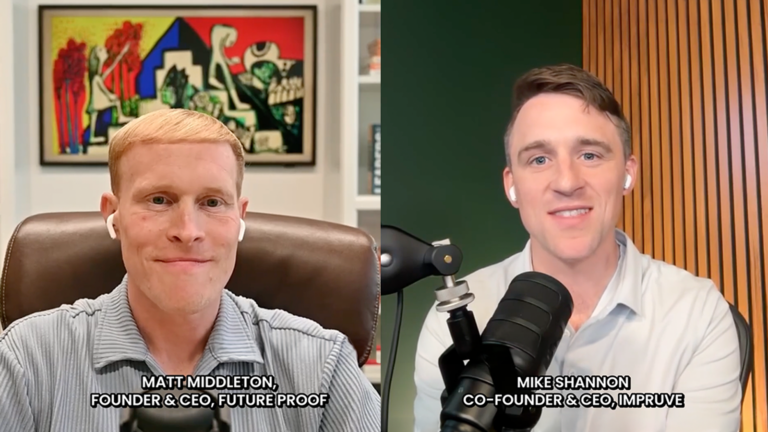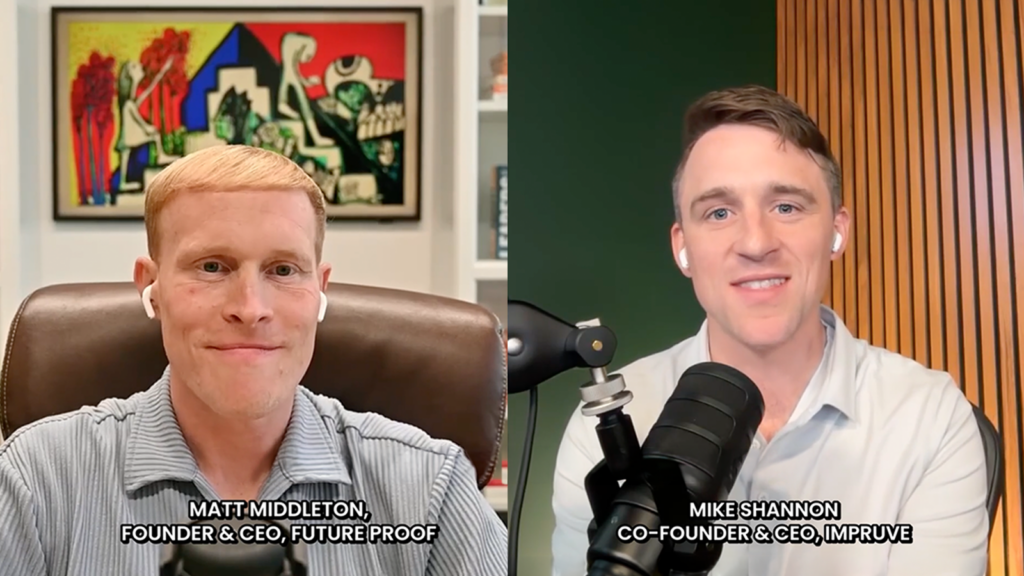
We recently spoke with Mike Shannon, Co-Founder and CEO of Impruve, on why a one-time AI strategy already has a short shelf life in this industry, and what an ongoing AI stewardship model looks like instead.
What Matt Middleton, Founder & CEO of Future Proof, keeps hearing from RIA leaders of all firm sizes is some version of the same question: what are other firms already doing, and how do we compare? Mike sees it too: “at every level there is a FOMO and a curiosity, and I think a healthy curiosity to the point that you’ll see these study groups or mastermind groups within the industry amongst competitors, sharing notes.”
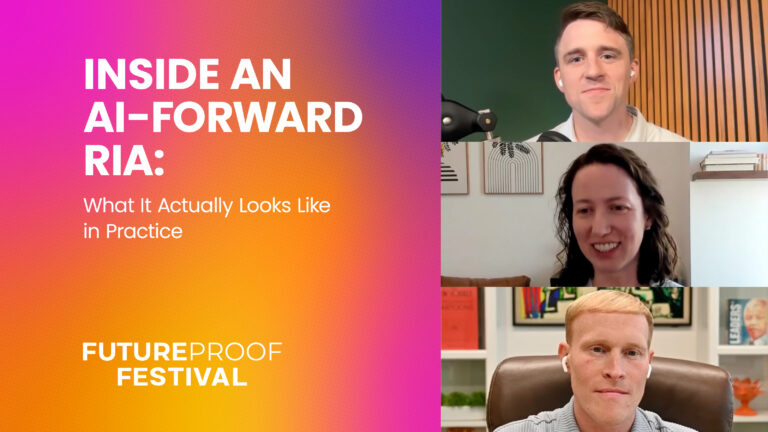
That’s the conversation we’ve been having with firms across the industry, sitting down with the people who are building AI practices from within, trying to understand what’s working, what isn’t, and what questions nobody has clean answers to yet. One of those conversations was with Dr. Kelly Wagman, Director, Head of AI Strategy at Cresset, who joined the firm last July. She’s been building Cresset’s AI practice and some of the questions she’s still working through are the same ones every firm is asking right now.
A governance framework that moves with the technology
Cresset runs AI governance as an ongoing process because the pace of change when it comes to technology is so fast.
They operate two AI Champion groups. A leadership-level group sets priorities and ensures the work is advancing business needs. A cross-functional group covering cybersecurity, policy, compliance, tech, and IT evaluates whether specific features or tools are safe to turn on.
“New features get released like every month,” Kelly said, “and they sometimes open up new access to data or let you do new things. And so we basically have everything off by default and we turn on either features or data access just on a case by case basis after it’s gone through evaluation by this group.”
No one group has veto power. It runs by consensus, with one shared starting point:
“The goal is to give people access to the best tools. We want to be not AI first, but [an] AI forward firm. Compliance and cybersecurity always comes first. So if we don’t feel like we can do it safely, we’re not gonna do it.”
Adoption built by organizational design
Shortly after Kelly joined, the AI team ran into a practical problem: they couldn’t be experts in every department’s workflow. The AI Champions program was their response: one representative from every department, there to identify use cases from within their area. Champions have two jobs: help prioritize use cases within their area, and “build out custom GPTs, skills, other types of workflows that don’t require engineering, and then share those within their departments.”
Across the firm, Kelly sees a spectrum of engagement: people who haven’t logged in, a “Google search tier, using it as kind of a glorified search engine, which again, not a bad place to start,” and people actively building custom tools. Champions are chosen to help move people through those stages.
How they’re chosen matters.
“It was a fairly fluid process,” Kelly said. “We didn’t pick people who knew a lot about AI per se. We picked people that were really passionate about learning, but who also were able to kind of understand their whole department.”
Mike previously mentioned seeing the same design challenge across firms: “You don’t necessarily want to put highly sensitive workflows in the hands of, you know, say a junior developer. On the flip side, you want your AI champions to have some freedom. And so if you could put the right structure around them, now you can have this bed of innovation where you can know that, hey, we’ve got AI champions that have access to, you know, whatever we’ve agreed on Claude or Open AI, but we can also observe it from a compliance and a financial standpoint.”
New capabilities, not just efficiency gains
Kelly described two categories of use cases that have taken hold.
One is what she calls “FAQ GPTs”: staff create a knowledge base, build a GPT on top of it, and deploy it internally for things like HR questions or compliance review. She describes these as “really powerful.”
The other shift is visual. Kelly described a wave of staff building dashboards, diagrams, and reports by attaching their own data sources, producing outputs that, not long ago, would have meant a long stretch in PowerPoint. “Even for things that are internal that wouldn’t have gone through marketing anyway and that people might have spent a long time building PowerPoints around, yeah, [they] can just be generated in this really nice HTML.”
Neither category fits neatly into an ROI framework, which is a question Kelly hasn’t resolved yet: “if it’s something where it was just you couldn’t do the thing before and now you can do it, how do you measure that?”
Mike had also put it simply from the outside: “Net new capability doesn’t have a line item on the budget at the moment.”
That’s what we’re trying to answer with the inaugural State of AI in Wealth Management Survey, the first effort to give firms across the industry an honest benchmark: what’s being built, where the gaps are, what the firms further along are doing differently, and how they’re measuring ROI. Results will be presented live on stage on Monday, September 14 at Future Proof Festival this September in Huntington Beach.
Take the survey here. Responses close August 21.
Disclaimer: This article was written with the help of AI. If we’re building an event about how AI is transforming finance, we’d be hypocrites not to use it ourselves. At Future Proof, we’re testing and deploying AI at every stage of the business: from how we research and write, to how we design, plan, and deliver events.