The wealth management industry is entering a period where the pace of technological change is outstripping the pace of human adaptation. Conversations that once centered on tools and workflows now revolve around psychology, culture, and identity. AI is a present force that is reshaping how firms operate, how advisors see their roles, and how clients experience guidance. As we’ve spoken with leaders across the industry in preparation for Future Proof Citywide, March 8-11, 2026 in Miami Beach, FL, it’s become clear that the real story is not about technology itself, but about what it is exposing inside organizations.
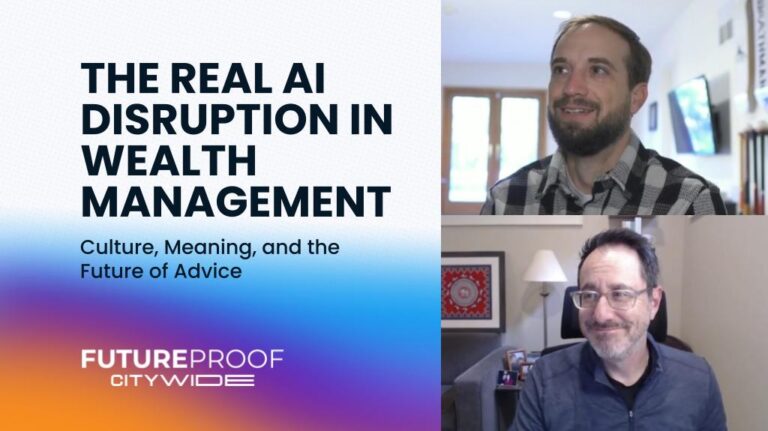
Across our research calls, a pattern has become unmistakable. Leaders are wrestling with three forces shaping the future of advice: AI is creating cultural strain by disrupting knowledge work and personal identity, the advisor role is shifting as the mechanical side becomes increasingly commoditized, and firms are beginning to see that the next competitive frontier is not personalization at scale but humanization at scale. These themes came into sharp focus during my recent conversation with Brian Portnoy, Founder of Shaping Wealth, whose perspective grounded these industry pressures in both psychology and practice.
AI Is Creating Cultural Strain Because It Disrupts Knowledge Work and Identity
When I asked Brian why AI feels so destabilizing, he focused squarely on the human reaction.
“I think AI challenges the culture of wealth organizations. I think it challenges the culture of every organization,” he said. “You’re never supposed to say this time is different, but it feels like this time is different.”
What makes it feel different? AI is not just automating physical labor. It is reaching into the work people associate with judgment, expertise, and identity. Brian described the result as “a low-grade terror” across knowledge professions because “it feels like there’s nowhere else to go.” For wealth management specifically, he observed something many leaders quietly acknowledge:
“If I have one major observation about this industry, it’s that the only job that most people have in our industry is keeping their job… and AI makes it feel like that is becoming flimsy.”
That cultural dynamic matters. Introducing AI as a pure efficiency play can deepen fear, resistance, and confusion. Without clarity about its purpose, AI becomes an existential question rather than an operational one. Brian noted that organizations that treat AI purely as a labor-reduction tool risk “serious cultural damage,” while those who begin with the actual human problems they’re trying to solve stand a better chance of adoption and trust.
Mechanics Will Be Commoditized and Guidance Will Be Amplified
To understand where AI will have the most impact, Brian went back to first principles. A few years ago, he asked advisors to describe what they actually do and received dozens of answers. He eventually distilled all of them into two core functions:
“What advisors do is they manage money and they manage humans.”
He often refers to these as the mechanic role and the guide role. Mechanics handle the technical elements of financial planning: portfolios, taxes, retirement planning, liquidity, insurance, estate issues. Guides help clients navigate uncertainty, emotion, grief, identity shifts, and change.
Brian’s view is direct:
“AI will increasingly commoditize the mechanics. And if used properly, AI will enhance and amplify the human brilliance and creativity that goes into being a very effective guide.”
He later gave a simple three-part structure that reflects this shift:
“The portfolio is the what, the plan is the how, and the purpose is the why.”
The closer advisors get to purpose, the more they enter the domain where AI can support but never replace human insight. That is where advisors become meaning-makers rather than model-builders, and where the true differentiation of the profession sits.
This dynamic is shaping how we build Future Proof Citywide. Leaders are trying to understand what the future advisor looks like when the mechanical side is increasingly automated and the human side becomes the primary source of value.
The Future Depends on Humanization at Scale, Not Personalization at Scale
The industry talks constantly about personalization. Brian believes that concept is no longer enough. AI can personalize surface-level details, but the future depends on something deeper.
“I would distinguish now… between personalization at scale and humanization at scale,” he said.
Personalization is factual. It’s CRM fields, birthdays, holdings, life events, preferences. Humanization is psychological. It’s how clients make decisions, how they process emotion, how they define happiness, what motivates them, how they experience change, and what they believe money is for.
Humanization is harder. It is “messier,” as Brian put it. But he emphasized that it is not unmanageable and not optional. The firms that learn to understand clients at that level, through frameworks, training, and thoughtful AI design, will deliver more meaningful advice and stronger long-term relationships.
This is also where agentic AI, in Brian’s view, becomes powerful if it is built intentionally. When he described Lydia, the AI system his team is building, what stood out was not the complexity of the architecture but the clarity of its purpose. It is designed to support the guide work: helping advisors recognize emotional patterns, supporting better decisions, and prompting richer human conversation.
The orientation is a more important focus than the technology itself technology is.
Where This Leaves the Industry
These themes point to an industry in transition. AI is accelerating change in ways that raise real cultural and psychological questions. It is forcing a deeper distinction between technical tasks and human guidance. And it is pushing firms to rethink what it means to scale understanding, empathy, and meaning. The future will not hinge on who deploys the most technology, but on who designs cultures where people can adapt to it with clarity rather than fear.
This is where Future Proof Citywide fits in. The industry does not need another showcase of tools. It needs an honest, interdisciplinary conversation about what AI is doing to the profession, what it is amplifying, what it is eroding, and how leaders can respond with intention. Future Proof Citywide is meant to bring together people who are confronting these questions from different vantage points – advisors, CIOs, CTOs, COOs, behavioral scientists, product builders, and leaders shaping the direction of their firms.
The future of advice will be defined by how well firms navigate the line Brian highlighted between mechanics and meaning, and by how thoughtfully they introduce AI into human workflows. Those are decisions that go beyond technology. They are cultural, behavioral, and strategic decisions. They require space to compare experiences, pressure-test assumptions, and learn from people experimenting at the edges.
Future Proof Citywide exists to create that space. Not to prescribe answers, but to convene the people who are asking the right questions and doing the real work. If the industry is moving from managing money to managing meaning, then the conversations that matter most are the ones that help us understand what that evolution looks like in practice, organizationally, psychologically, and technologically.
If you want to be part of the conversation shaping what this evolution looks like in practice, Future Proof Citywide is the place to do it. Join leaders who are thinking deeply about the future of guidance, culture, and human-centered AI. Don’t miss your chance to learn, connect, and prepare yourself and your firm for what’s next, register now.
Author
Nyle Bayer
CMO, Future Proof
Nyle Bayer is the Chief Marketing Officer of Future Proof, where he is responsible for creating, implementing, and executing go-to-market strategies for the venture studio and incubator behind the Future Proof Festival. Nyle’s professional history includes years as a practicing financial advisor and executive experience as a CMO at a variety of companies ranging from an RIA to an asset manager to fintech companies, both bootstrapped and venture-backed. His passion for expanding access to financial services and products that enable the next generation of investors, as well as changing the perception of what wealth is to the public, has guided his career.
Disclaimer: This article was written by me … with the help of AI (ChatGPT 5.1 to be specific). If we’re building an event about how AI is transforming finance, we’d be hypocrites not to use it ourselves. At Future Proof, we’re testing and deploying AI at every stage of the business: from how we research and write, to how we design, plan, and deliver events. Consider this both an experiment and a preview of what’s to come.