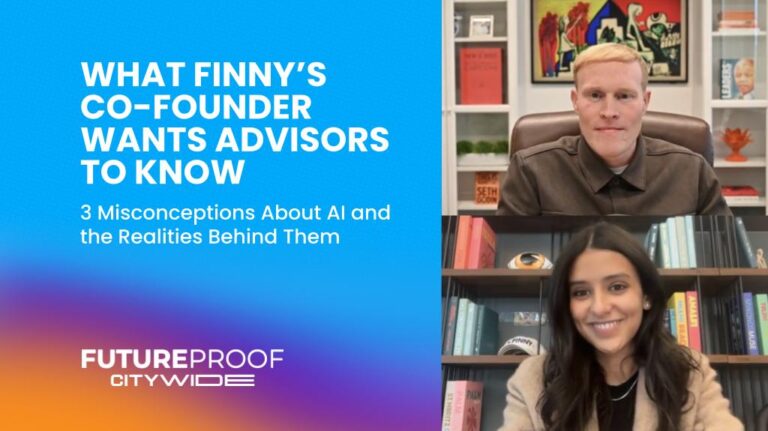
Across the industry, firms are wrestling with how AI will change the advisor role, reshape firm growth, and influence the pace of innovation. My conversation with Eden Ovadia, Co-Founder of FINNY, highlighted how much uncertainty still exists around those questions, and how differently they can look depending on where you sit.
Eden brings a distinctive mix of experience to the discussion. Before co-founding FINNY, she worked in private equity and M&A diligence within wealth management, where she saw firsthand how firms pursued growth and where those strategies fell short. She also has formal training in technology and machine learning, and now spends her time working closely with advisory teams as they experiment with AI-enabled tools inside their day-to-day workflows. That combination gives her a practical vantage point on both the structural challenges firms face and the realities of applying AI inside advisory businesses.
Below are three misconceptions across wealth management today, paired with the realities Eden articulated during our conversation.
Misconception 1: “AI will replace advisors.”
This concern surfaces frequently, on conference stages, in media narratives, and in quieter conversations among advisors trying to understand what their role will look like over the next decade. From Eden’s perspective, this framing misses the point.
As she explained:
“AI makes a lot of manual or repetitive, low-complex work not required to do by humans anymore… But the reason Betterment and Wealthfront didn’t replace advisors is because ultimately this is a profession that’s not going anywhere.”
She’s watched AI meaningfully reduce the work that overwhelms advisors today – notetaking, research gathering, content drafting – the same work that historically required junior staff. In her view, none of that diminishes the core value of advice itself.
As she put it:
“The human urge to find human interaction is only going to increase as we have an increased dependency on AI.”
The misconception is that AI competes with advisors.
The reality, in her view, is that AI reduces the work around the relationship so advisors can focus more fully on the relationship itself.
Misconception 2: “Organic growth is just about new clients.”
This assumption sits at the center of how many firms think about growth. Eden’s experience in M&A diligence shaped her view that the industry has often relied on acquisitions because it lacked a consistent, repeatable way to grow organically.
She explained:
“It was so clear this was the second best thing in the absence of real growth… No one actually knows how to grow, so they spend these huge amounts of money being incredibly capital inefficient.”
Her observations come from living inside those economics, watching firms deploy capital into acquisitions because the alternative was hoping referrals would materialize. From her perspective, that dynamic revealed a structural gap rather than a lack of ambition.
When she talks about FINNY, she frames its purpose in simple terms:
“From a first-principles perspective, the only thing that FINNY is doing is making people who like to make money, make money in a more efficient way.”
Rather than limiting organic growth to new client acquisition, she sees growth opportunities embedded within existing relationships.
As she said:
“Organic growth is not always just new clients… you can deepen your relationship with the clients you already have.”
That perspective reflects what she hears across firms of different sizes. Growth signals often already exist, in life events, career changes, market conditions, or shifts in client behavior, but firms have not always had the systems or data structures to surface them in time to act.
The misconception is that organic growth equals prospecting.
The reality, as Eden sees it, is that growth depends on structured data and timely insight, enabling advisors to engage people at the right moment, whether or not they are new clients.
Misconception 3: “AI models will outpace startups, there’s no point building on top of them.”
This misconception is especially common among founders, technologists, and product teams. Eden has seen this fear up close, especially during her time at Y Combinator, where the arrival of every new OpenAI release created a wave of anxiety.
She recalled:
“Everyone was so nervous that OpenAI was going to release something that would make their company obsolete… It was like, who is going to die this week?”
From her vantage point, that fear hasn’t played out the way many expected. Foundational models have continued to evolve, but they haven’t eliminated the need for products that understand specific workflows or industries.
As she noted:
“OpenAI still hasn’t come up with anything like that. And no one really has. It’s the application layer, the innovators and the product people building on that, who are capitalizing in the near term.”
Her outlook is grounded in adaptability rather than prediction.
“You can spend so long worrying about something that doesn’t actually come to reality. The best thing you can do is do the best with the information you have today, and then be quick to innovate as your situation changes.”
The misconception is that model updates will eclipse innovation.
The reality, in her view, is that differentiation comes from understanding real workflows, designing useful experiences, and iterating as conditions change.
Breaking Down Misconceptions and Getting Into the Realities at Future Proof Citywide
Conversations like the one I had with Eden are a reminder that much of the industry’s thinking around AI is still shaped by outdated assumptions. The misconceptions she highlighted – about advisor displacement, about what organic growth really is, and about where innovation will come from – are exactly the kinds of beliefs holding firms back from meaningful progress.
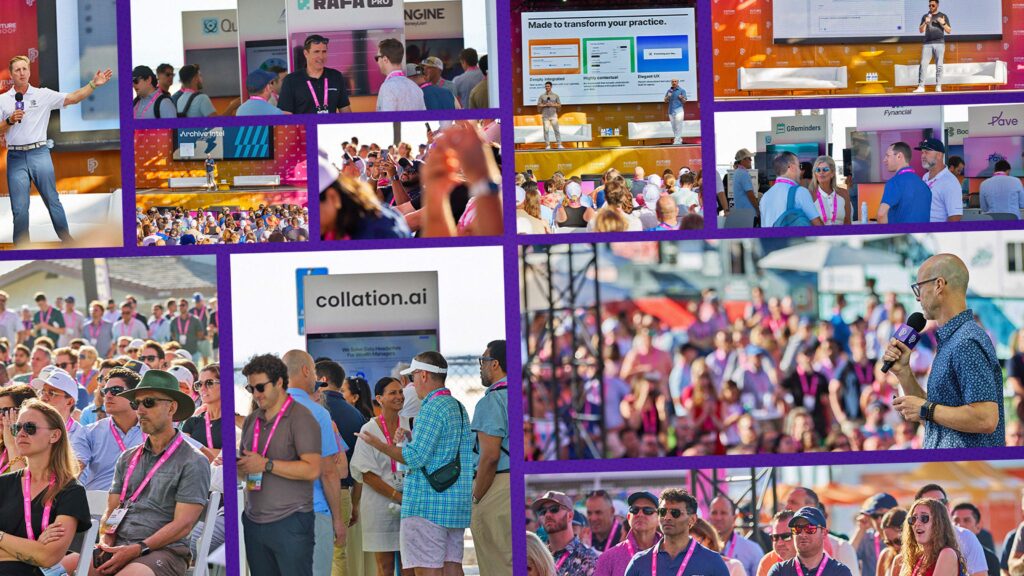
At Future Proof Citywide (March 8-11, 2026, Miami Beach, FL), our goal is to move the industry beyond surface-level narratives and into the realities shaping how firms operate, compete, and grow in an AI-first era. Eden’s perspective is one among many we’re bringing together – founders, CIOs, product leaders, researchers, advisors, and investors – each offering a different angle on what “AI readiness” actually looks like.
By putting these voices in the same areas, on the same stages, and across thousands of curated Breakthru Meetings, we’re creating an environment where leaders can pressure-test their assumptions, refine their strategies, and leave with a clearer understanding of how to build firms that thrive amid rapid change.
Breaking down misconceptions is the first step.
Building toward the realities is the work ahead.
And Future Proof Citywide is where that work begins. Register now to be a part of it.
Author
Matt Middleton
Founder & CEO, Future Proof
Matt Middleton is the founder and CEO of Future Proof, the company behind the world’s largest AI-native finance event, Future Proof Citywide. He leads the vision for building community-driven experiences that connect the most forward-thinking investors, advisors, technologists, and creators redefining financial services.
Disclaimer: This article was written by me … with the help of AI (ChatGPT 5.2 to be specific). If we’re building an event about how AI is transforming finance, we’d be hypocrites not to use it ourselves. At Future Proof, we’re testing and deploying AI at every stage of the business: from how we research and write, to how we design, plan, and deliver events. Consider this both an experiment and a preview of what’s to come.